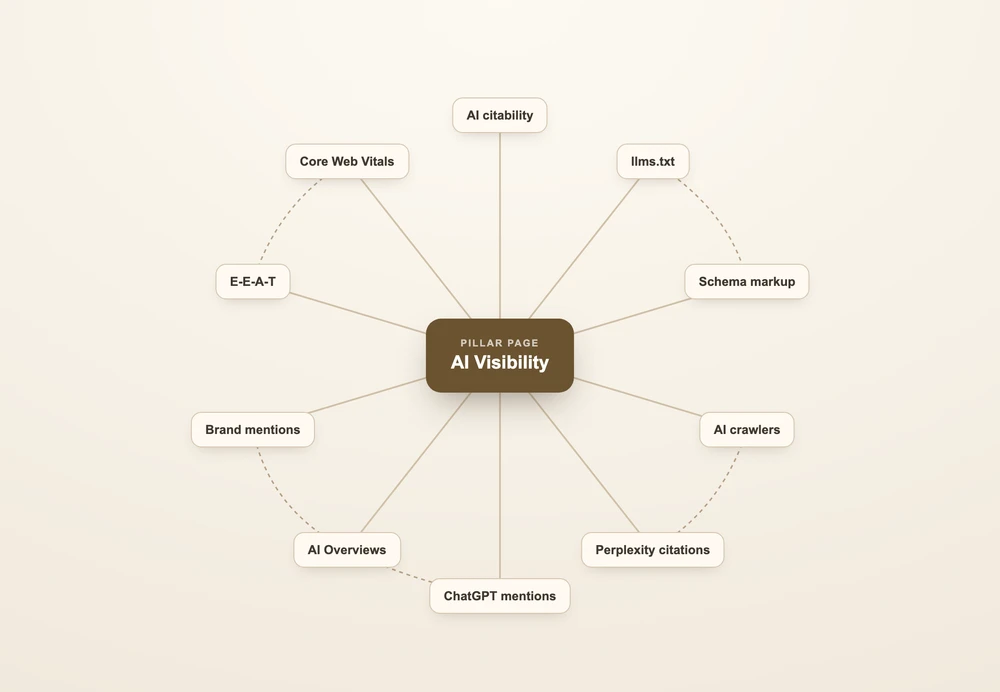
Topical authority is how thoroughly your site covers one subject. A site with topical authority treats its main topic in depth across many connected pages, like a chapter in an encyclopedia. It is not one lonely article. In topical authority SEO terms, this depth is how a site earns the right to be the source AI quotes.
Maybe a competitor with twenty articles on your subject gets all the AI mentions, while your handful of scattered posts get none. This guide explains why, and how to build the depth that changes it, page by page.
What is topical authority?
Topical authority is broad, organized coverage of a single subject. Picture an encyclopedia chapter rather than a stray article. The chapter covers the whole topic, section by section, with each part linking to the others. That is what authority looks like to a machine.
The opposite is the lonely article. One good post on a topic, surrounded by posts about everything else. It might be excellent. But on its own, it does not signal that you are the place to go for that subject.
So topical authority is something you build, not something you have. It grows page by connected page until your site clearly owns the subject.
Why do AI assistants prefer specialists?
AI assistants prefer specialists because they are trying to give a trustworthy answer. When an AI names a source, it leans toward sites that read as the recognized go-to authority on the topic. Broad, organized coverage is how a site earns that status.
Think about how you would answer a question yourself. You would point to the person who has clearly studied the subject in depth, not the person who mentioned it once. AI systems make the same call, at scale.
This is where the timeless rule meets the new one. Good content has always built trust. The AI era just made depth more visible and more decisive. A deep, organized body of work on one topic is how a site becomes the specialist AI reaches for. For the wider picture, see the complete guide to E-E-A-T for AI search. E-E-A-T stands for Experience, Expertise, Authoritativeness, and Trustworthiness.
How is topical authority scored?
A visibility audit scores topical authority on a simple three-band scale. You can place your own site against it in a minute. The audit asks one question: how thoroughly does the site cover its core subject across multiple pages?
| Band | What it looks like | Points |
|---|---|---|
| Thorough | The core topic is covered in depth across multiple connected pages | 3 |
| Some coverage | The topic is touched on, but not deeply or widely | 1 |
| Isolated | One stray article, no real coverage of the subject | 0 |
Be honest about where you sit. Most small-business sites land in the middle band. They have a few good posts but no organized body of work. That is the gap this article helps you close.
The site-wide modifier: 20+ pages earns a bonus, under 5 earns a penalty
Here is the part that should grab your attention. Topical authority is the one content factor in the audit that can add to or subtract from your final score. Most checks only contribute points. This one applies a modifier to your whole content score.
The modifier works on how many comprehensively clustered pages you have on your core topic:
| Tier | Pages on the core topic | Modifier |
|---|---|---|
| Authority | 20+ pages, well clustered | +10 |
| Developing | 10–20 pages, some clustering | +5 |
| Emerging | 5–10 pages | 0 |
| Thin | Fewer than 5 pages, no clustering | −5 |
The final score is capped at 100. The takeaway is plain. Moving from under 5 pages to 10 or more does not just add a few points here and there. It swings you across two tiers, from a penalty to a bonus. Few other moves in the audit shift your score that far.
Pillar pages and clusters: the structure that signals authority
The structure that signals authority is called a pillar-and-cluster model. A pillar page is one central page that covers your core subject broadly. A content cluster is the set of focused pages around it. Each one covers a single subtopic in depth. All of them link back to the pillar and to each other.
Picture a wheel. The pillar is the hub. The subtopic pages are the spokes. Strong internal links are what hold the wheel together. That linking is what tells a machine these pages belong to one body of work, not a random pile.
So the build is concrete. You create one pillar page on the core subject. Then you publish 10 to 20 interlinked subtopic pages covering the major parts of that subject, especially the parts your competitors already cover. For the linking craft, see internal linking strategy for SEO and AI discovery.
Finding the gaps: what the assessment looks at
The assessment looks at five things. Each one turns into a question you can ask about your own site. Run through them and your gaps become obvious.
- Breadth. Do you cover the major subtopics of your subject, or only one corner of it?
- Depth. Does each page treat its subtopic properly, or skim it?
- Clustering. Are your pages linked into one connected body, or scattered and orphaned?
- Gaps. What subtopics do competitors cover that you have skipped entirely?
- Competitor comparison. Set side by side, does your coverage look like the specialist's or the dabbler's?
That last point stays qualitative. The audit compares how thoroughly you cover the subject against others. It does not score your competitors' rankings. The goal is to find the holes in your map, then fill them.
Depth still counts: a cluster of thin pages isn't authority
A warning before you start. Twenty pages do not earn authority if all twenty say almost nothing. A cluster of near-empty pages is not authority. It is just a bigger pile of thin pages, and machines see through it.
Each page has to carry its own weight. The audit judges single-page depth too. It rewards a thorough, expert treatment of a subtopic and gives no credit to a superficial one. So the count matters, but only when each page is genuinely useful.
This is why count and quality go together. Aim for 10 to 20 pages, and make each one substantial. For the page-length side, see how long each page should be. For the trap to avoid, see why thin content drags your whole site down.
A 90-day build plan for a small business
You build authority in sequence, not all at once. Here is a realistic 90-day plan for a small team. It is a build plan, not a promise of a ranking by day 90.
- Pick one core topic. Choose the subject you most want to be known for. Resist covering three at once.
- Write the pillar page first. One broad, genuinely useful page on the core subject. This becomes your hub.
- Ship two subtopic pages a month. Pick the subtopics from your gap list. Make each one substantial.
- Interlink as you go. Every new page links to the pillar and to related subtopic pages. Never leave a page orphaned.
- Revisit the cluster quarterly. Refresh older pages, fill new gaps, and add depth where it is thin.
Frame your progress against the tiers. Getting from under 5 pages to 10 or more moves you out of the penalty band and toward the bonus. That is the single highest-leverage content move on most sites.
Frequently asked questions
What is topical authority in plain terms? It is how completely your site covers one subject. A site with topical authority treats its main topic in depth across many connected pages, like an encyclopedia chapter, rather than one stray article.
What is the difference between a pillar page and a content cluster? A pillar page is the one central page covering your core subject broadly. A content cluster is the group of focused subtopic pages around it, each covering one part in depth and linked back to the pillar.
How many pages do I need for topical authority? Aim for 10 to 20 strong, interlinked pages on one core subject. Fewer than 5 with no clustering is the weakest tier. Around 20 well-clustered pages is the strongest. Quality per page matters as much as the count.
Does topical authority help with AI citations or just Google? Both. The same depth that earns trust in traditional search makes you the recognized specialist AI assistants prefer to cite. It is one investment that pays off across search and AI answers.
What to do first
Do not try to fix everything. Start with the single highest-leverage step:
- This week: pick the one core topic you want to own, and list the subtopics competitors cover that you don't.
- This month: write or upgrade your pillar page so it covers the core subject properly.
- This quarter: ship two strong subtopic pages a month and interlink them as you go.
To see exactly where you stand, run a free visibility audit. It counts and maps your topic coverage. It tells you which band and which modifier tier you are in. Then it shows what the next tier requires. From there, the build plan above is a steady, page-by-page climb.