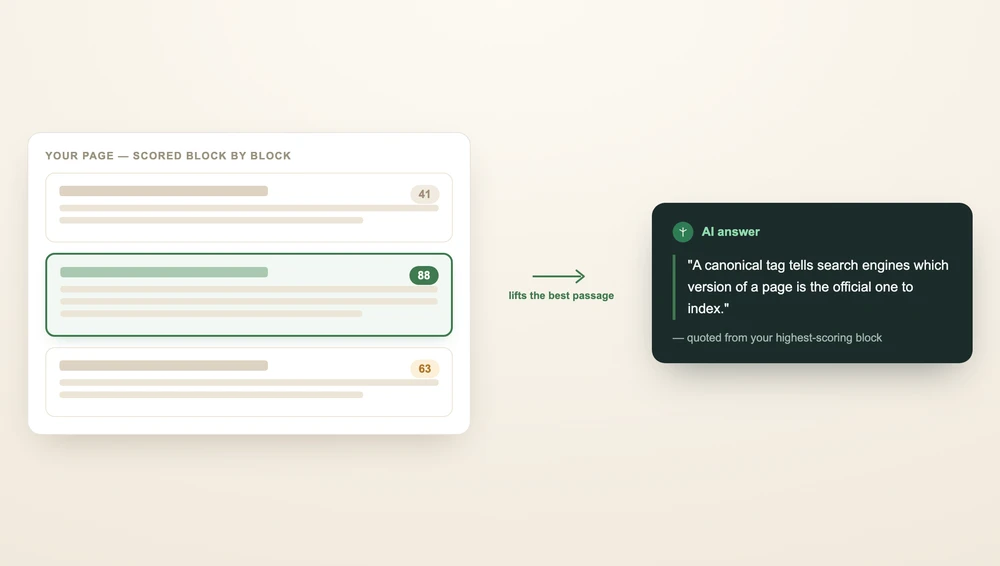
To get cited by ChatGPT, write each section so it works as a standalone answer. AI assistants do not quote whole pages. They lift one passage that reads as a complete, self-contained reply. So "how to get cited by ChatGPT" is really a writing question. Is any single block of your text good enough to quote on its own?
That is what AI citability means. This guide is the hub for it. We'll cover the five tests every passage faces. We'll cover the rules that move each one, and where to go deeper. You can apply most of it today, with simple before-and-after edits.
What is AI citability?
AI citability is how likely an AI assistant is to quote a passage from your page in its answer. It applies to tools like ChatGPT, Perplexity, Google's AI Overviews, and Gemini. High citability means your text reads as a clean, self-contained answer. Low citability means the AI has nothing it can lift cleanly, so it cites someone else.
Here is the key shift. Old search rewards a page that ranks. AI rewards a passage that answers. For the bigger picture of that shift, start with our guide to what GEO (Generative Engine Optimization) is. This article zooms in on the writing craft underneath it.
AI doesn't read your page — it extracts passages from it
AI systems break your page into blocks. Each heading starts a new block. The system then scores each block on its own and quotes the strongest one. It does not read your page like a person does, top to bottom.
This is why a page can be great for humans and useless to AI. Your point might be spread across five paragraphs. A reader follows the thread. A machine grabs one paragraph and needs the whole answer inside it. Only passages that survive on their own get used.
Think of it like a quote board. The AI is scanning for one line it can pin up without any backstory. If your best insight only makes sense after three paragraphs of build-up, it never makes the board.
The five tests every passage faces
Every block of your content is judged on five things. They do not carry equal weight. Our visibility audit scores each block on all five and combines them into one citability score per passage. Here is the framework you can apply yourself.
| Test | Weight | The question it asks |
|---|---|---|
| Answer first | 30% | Does the opening sentence state the conclusion? |
| Self-contained | 25% | Does the passage make sense cut out and alone? |
| Structure | 20% | Can a machine parse the headings, lists, and tables? |
| Statistical density | 15% | Are there hard, specific facts, not vague claims? |
| Uniqueness | 10% | Is this the only place a fact can be found? |
The biggest weight goes to answering first. So that is where you start. Let's walk through each test with fixes you can copy.
Test 1: answer first — state the conclusion in the opening sentence (30%)
Open every section with a direct answer in the first sentence. Make the first 40 to 60 words stand alone. A section that opens with a story and saves the point for the end is the lowest-scoring kind. There is no answer for the AI to extract near the heading.
The strongest pattern is the definition sentence. Write "X is...", "X means...", or "X refers to...". Definition-style sentences roughly double a passage's chance of being quoted. That comes from the Princeton GEO study (Aboutaleb et al., 2024). Treat it as a dated finding, not a fixed law. The reason is simple. A complete sentence is something a machine can lift without editing.
Here is a before-and-after.
- Weak: "There are a lot of factors that go into pricing, and many homeowners are surprised when they start looking into it..."
- Strong: "A home solar system costs roughly $15,000 to $25,000 before incentives. The price depends on roof size, panel quality, and your state."
The strong version states the answer in the first 40 to 60 words. It also names the subject. That is exactly what an AI can quote.
Test 2: the scissors test — self-contained passages (25%)
Imagine cutting a passage out with scissors and handing it to a stranger. If they understand it with no other context, it passes. If they ask "what is 'it'?" or "this what?", it fails. AI reads one block at a time, so every block must survive on its own.
Run each passage through this five-point checklist:
- Name the subject. Say "the SolarMax panel", not "it" or "this product".
- Make the point clear alone. No reliance on the paragraph above.
- Include one specific fact. A number, a name, a date.
- Keep it the right length. Aim for one solid paragraph, not a fragment or a wall.
- Don't open with a conjunction. "But", "However", and "And" imply missing context.
The most common fix is killing pronouns. Words like "it", "this", and "as mentioned above" point to context the AI cannot see. Replace them with the actual name. One concrete fact per passage seals it.
Test 3: structure machines can parse — headings, lists, and tables (20%)
Use clean structure so machines can read your layout, not just your words. That means a clear heading order (H1, then H2, then H3, with no skipped levels). H1 to H6 are simply heading levels, like chapter and section titles. It also means question-style headings, short paragraphs, and tables for comparisons.
Question headings work because people ask AI assistants questions. A heading titled "How much does solar cost?" is a perfect match for a real query. The AI sees the question and the answer sitting right below it.
Tables earn their keep too. AI tools extract tables with high fidelity for "X vs Y" questions. A clean comparison table is one of the most quotable things on a page. For the deep dives, see our guide to heading structure for SEO and AI. There is also a full guide to tables and lists: formatting content so AI can quote it.
Test 4: hard numbers beat mushy claims — statistical density (15%)
Pack each section with specific, verifiable facts. That means exact percentages, dollar amounts, dates, named studies, and real counts. Vague quantifiers do not count. "Many experts agree" and "studies show" add nothing a machine can quote with confidence.
Always attribute the number. Use the pattern "According to [Source], [fact]". This matters most for Perplexity, which favors fact-dense passages and cross-checks claims against other sources. So link a corroborating source when you can. A verifiable claim is a citable claim.
Here is the swap:
- Weak: "Solar can save you a lot of money over time."
- Strong: "A typical home solar system pays for itself in 8 to 12 years, according to the U.S. Department of Energy."
The strong line names a source and a real range. That gives the AI something to stand behind. For the strategy behind it, see how to cite sources and experts in your content.
Test 5: be the only source — uniqueness and original data (10%)
Own a fact no one else has. The strongest citability position is being the sole source. If a number can only be found on your page, citing you is not optional. It is necessary. The AI has to name you.
Content copied from higher-authority sites scores lowest. There is no reason to quote you over the original. First-party research scores highest: surveys, proprietary data, or an original framework with a clear method. Even a line like "Our analysis of 200 client projects found..." can earn the cite, because no one else can say it.
This is a big lever, so it has its own guide. Read why original research is the #1 way to get cited by AI for the full playbook.
How long should a quotable passage be?
Aim for one solid paragraph per idea — a tight block, not a fragment and not a sprawl. AI tools tend to quote passages of about 134 to 167 words. That comes from the Bortolato 2025 analysis, a single study, so treat it as directional. That length is about one well-built paragraph under its own heading.
The fix is mechanical. Merge two-sentence stubs that float alone. Split paragraphs that run too long and bury two ideas. The goal is one self-contained idea, one clear answer, sized like a paragraph a person would happily quote.
Name names: entity clarity inside every passage
Name your brand and subject in full inside each passage. Write "Acme's SolarMax panel", not "our product" or "it". Machines read one paragraph at a time. An explicit name lets the AI attribute the fact to the right business. That way the quote carries your brand name into the answer.
Practice this rule: use the full proper name at least once per passage. Bold a key term on the first use. Keep paragraphs to two to four sentences, one idea each. Put the key claim in the first sentence and the evidence after. A one-sentence stub or a five-sentence block is a weak passage.
Your page openings are your best citation slots
Treat the opening passage of every page as prime real estate. AI systems most often extract the opening when they summarize or describe a page. A weak opening wastes your best citation slot. A strong one hands the AI a ready-made quote.
So write each opening as one to three self-contained sentences. Name the company or topic. State the key answer right away. Notice that this article opens with a direct answer to its own title. We practice what we preach, because that opening block is the one most likely to be quoted.
How do you measure progress: average score vs coverage?
Track two numbers, not one. The first is your average citability score across a page. The second is coverage: the share of blocks that are strong enough to quote. A page can have a decent average while most sections are still weak. A few great blocks can hide many poor ones.
Coverage matters because the AI may land on any block. Breadth beats a single hero paragraph. The improvement loop is simple. Find your weakest blocks, then fix them one at a time. Add an answer-first opening and one hard fact to each. Repeat until most of the page is quotable.
Our visibility audit grades every section of your key pages on these five dimensions. It returns the three weakest blocks with concrete rewrite suggestions. AI citability is the single largest part of the GEO score, so it is where points move fastest.
A quick checklist for any passage
Before you publish a section, run it through these:
- Does the first sentence state the answer in 40 to 60 words?
- Would it make sense cut out and read alone?
- Did you name the subject instead of using "it" or "this"?
- Is there at least one specific, sourced fact?
- Is it about one paragraph long, on one idea?
- Are your headings phrased as questions where it fits?
If you can tick all six, the AI has something clean to quote. That is the whole job.
Frequently asked questions
How do I get cited by ChatGPT specifically? Write answer-first passages and feed Bing's index. ChatGPT's web search runs on Bing, not Google. So make sure your site is in Bing and that each key section opens with a direct, self-contained answer. ChatGPT leans on trusted sources, so clear attribution helps too.
Will following these rules guarantee a citation? No. Nothing guarantees a citation. These rules raise the odds by giving AI clean, quotable passages to work with. Think of it as improving your chances, not buying a result. Anyone promising guaranteed AI citations is guessing.
Does AI citability help my normal Google rankings? Usually yes. Answer-first writing, clean structure, and credible facts are good writing by any measure. They help human readers and search engines alike. You are not trading one for the other.
What is the single most important citability fix? Answer first. Open every section with a direct answer in the first sentence, and name the subject. It carries the most weight and is the fastest to apply across a whole site.
How do I check my own citability? Read each section out of context and ask if it stands alone. For a scored, section-by-section view, run a visibility audit. It flags your weakest blocks and suggests specific rewrites.
The bottom line
Getting cited by AI is a writing craft with rules you can learn. AI quotes passages, not pages. So make each section a standalone answer. Lead with the conclusion, name the subject, and add one hard fact. Size each one like a tight paragraph. Then widen your coverage so most of the page is quotable, not just the best block.
Start with answer-first openings on your most important pages. It is the biggest lever and the easiest first move. Run a free visibility audit to see which passages AI can quote today. It also shows you how to fix the ones it can't.